






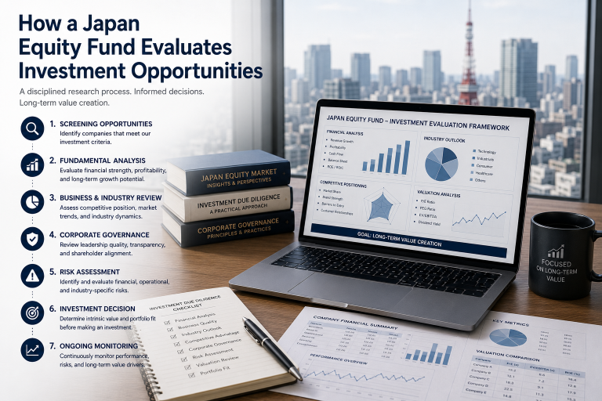
Investing successfully in Japanese equities requires more than identifying companies with attractive valuations. Every investment decision should be supported by detailed research, financial analysis, and a clear understanding of the factors that influence long-term business performance. This disciplined approach helps investors distinguish businesses with sustainable growth potential from those facing structural challenges.
A professionally managed japan equity fund follows a structured investment due diligence process before adding any company to its portfolio. Rather than reacting to short-term market movements, fund managers evaluate each opportunity based on business fundamentals, financial strength, competitive positioning, and long-term value creation. This comprehensive approach supports informed investment decisions while helping to manage portfolio risk.
Why Investment Evaluation Matters
Japan’s equity market offers a wide range of investment opportunities across industries, from globally recognised manufacturers to specialised small-cap businesses. While many companies demonstrate strong operational performance, not every business aligns with a fund’s long-term investment objectives.
Evaluating opportunities before investing helps fund managers:
- Identify businesses with sustainable growth potential.
- Assess financial strength and operational stability.
- Understand industry-specific risks.
- Compare investment opportunities objectively.
- Build a portfolio designed for long-term value creation.
A disciplined evaluation process ensures that investment decisions are based on research rather than market sentiment.
The Role of Investment Due Diligence
Before investing, every opportunity should undergo a comprehensive review. A structured investment due diligence process enables fund managers to analyse a business from multiple perspectives, reducing uncertainty while improving investment confidence.
Rather than focusing only on current financial performance, due diligence seeks to answer broader questions about a company’s future potential. This includes understanding how the business generates revenue, competes within its industry, allocates capital, and manages long-term growth.
By following a consistent research framework, investment managers can make decisions supported by evidence rather than speculation.
Screening Potential Investment Opportunities
The evaluation process typically begins by identifying companies that meet specific investment criteria. This initial screening helps narrow a large investment universe into a smaller group of businesses suitable for detailed research.
Common Screening Factors
Investment managers often review:
- Market capitalisation
- Industry exposure
- Financial performance
- Valuation metrics
- Balance sheet quality
- Liquidity
Screening allows managers to focus their research on companies that align with the fund’s investment philosophy and long-term objectives.
Analysing Business Fundamentals
Once a company passes the initial screening stage, the next step is to understand how the business operates and whether it possesses the characteristics needed to generate sustainable shareholder value.
Rather than relying solely on financial ratios, fund managers evaluate the overall quality of the business and its ability to perform throughout changing market conditions.
Key Areas of Fundamental Analysis
A comprehensive review generally includes:
- Revenue growth trends
- Profitability
- Cash flow generation
- Debt management
- Return on capital
- Earnings sustainability
Together, these indicators provide valuable insight into a company’s financial health and long-term resilience.
Evaluating Competitive Position
A company’s long-term success depends not only on financial performance but also on its ability to maintain a competitive advantage within its industry.
Fund managers assess whether a business has qualities that can support future growth while protecting profitability against changing market conditions.
Important factors include:
- Market leadership
- Brand strength
- Proprietary technology
- Customer relationships
- Operational efficiency
- Barriers to entry
Companies with durable competitive advantages are often better positioned to deliver consistent long-term performance.
Reviewing Corporate Governance
Corporate governance plays an increasingly important role in investment decision-making, particularly within Japan’s evolving equity market. Strong governance often reflects effective leadership, transparent reporting, and responsible capital allocation.
During the evaluation process, managers assess whether company leadership demonstrates a long-term commitment to creating shareholder value.
Governance Areas Commonly Reviewed
- Board independence
- Executive accountability
- Shareholder communication
- Capital allocation decisions
- Strategic planning
- Corporate transparency
Well-governed businesses often make more disciplined decisions that contribute to sustainable growth.
Assessing Investment Risks
Every investment carries a degree of uncertainty, making risk assessment an essential part of the evaluation process. Rather than attempting to eliminate risk, fund managers seek to understand where potential risks exist and whether they are appropriately balanced against future opportunities.
Risk assessment extends beyond market volatility to include company-specific and industry-related factors.
Common Risk Considerations
Investment managers evaluate:
- Financial leverage
- Industry competition
- Economic sensitivity
- Liquidity risk
- Valuation risk
- Operational challenges
Understanding these risks helps support more balanced and informed investment decisions.
Making the Final Investment Decision
After completing detailed research, financial analysis, governance reviews, and risk assessments, investment managers determine whether the company meets the fund’s investment criteria.
The decision is based on the overall quality of the business rather than a single financial metric or short-term market trend. Managers also consider how the company fits within the existing portfolio and whether it contributes to the fund’s long-term investment objectives.
This disciplined decision-making process helps maintain consistency across the portfolio while ensuring every investment aligns with the fund’s strategy.
Why Long-Term Discipline Matters
Successful investing requires patience and consistency. Short-term market movements may create temporary opportunities or challenges, but long-term returns are often driven by business fundamentals, management quality, and disciplined portfolio management.
A professionally managed japan equity fund continues monitoring portfolio companies after the initial investment. Ongoing research ensures that businesses continue to meet investment expectations while allowing managers to respond thoughtfully to changing conditions.
By maintaining a structured investment due diligence process, investment managers can continuously evaluate opportunities, monitor risks, and make informed decisions that support sustainable long-term value creation.
Conclusion
Evaluating investment opportunities requires much more than reviewing financial performance or market trends. A successful japan equity fund relies on detailed research, comprehensive business analysis, governance assessment, and disciplined decision-making before investing in any company.
A structured investment due diligence process provides the framework needed to identify high-quality businesses, assess potential risks, and build a resilient portfolio focused on long-term growth. As Japan’s equity market continues to evolve, combining thorough research with consistent investment discipline remains essential for making informed investment decisions and creating sustainable shareholder value.